Disclaimer
This is a work of pure fiction. Every character, event, location, and act described is entirely imaginary. No real person, animal, or place is depicted. The story explores extreme dark fetish themes involving graphic violence, slaughter imagery, and non-consensual horror for adult readers who specifically seek such material. It is not instructional, not endorsing, and not connected to any real-world act. Reader discretion is mandatory. If this content is not what you want, stop reading now.
From the Hook to the Counter: The Widow Who Became the Meat
In the damp hollow of Blackthorn Vale, where the fog never fully lifted from the pig pens and the soil stayed dark with old blood, Widow Elara Crowe sold pork the way other women sold bread. Every dawn she rose before the cockerels, sharpened her knives on the whetstone that had belonged to her late husband, and laid out the day’s cuts on the long wooden counter beneath the tin roof of her stall. Shoulder. Belly. Trotters. Head cheese. The air around her always smelled of iron and fat.
People came because her meat was clean and her prices fair. They did not come because they liked her. Elara spoke little. Her eyes stayed flat. When a customer asked for a particular cut she would answer with a single word and the wet sound of the cleaver. She had been alone for eleven years. The villagers said the loneliness had cured her of softness the way salt cures a ham.
On the morning of the fourteenth of October the first buyers arrived while the mist still clung to the ground. Old Mrs. Harrow was first, wanting three pounds of belly for the week’s stews. She stepped up to the counter, set her basket down, and froze.
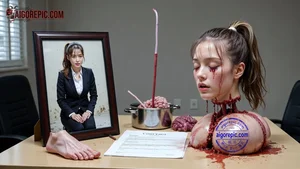
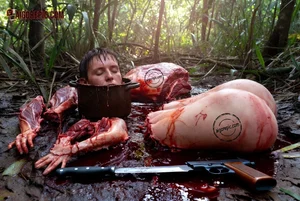
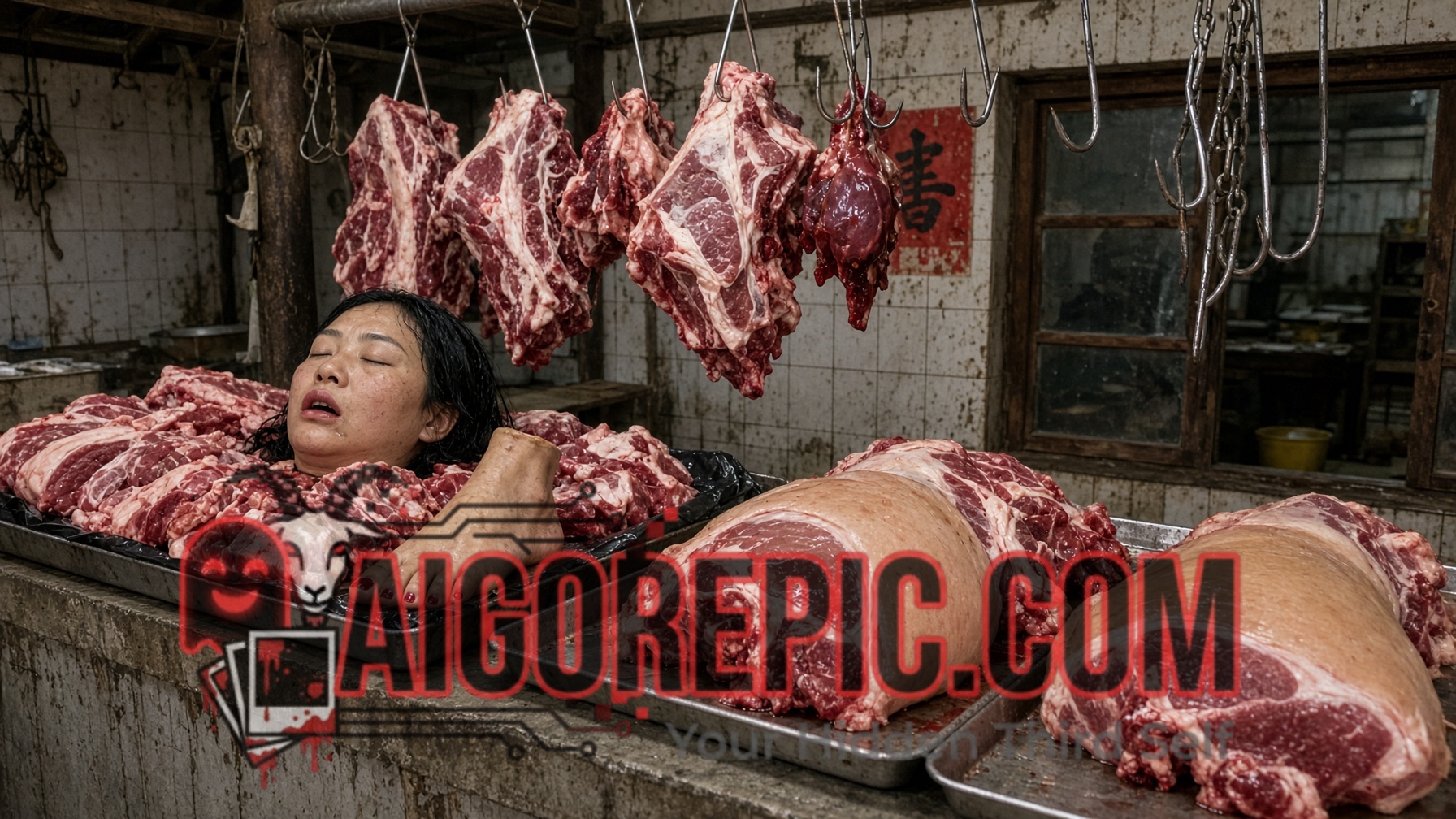
Elara’s head sat on a neat bed of chopped shoulder meat, eyes open, mouth slightly parted as if she had been about to speak. The rest of her body had been dressed exactly as a hog is dressed after the scald: split down the spine, ribcage opened, organs removed, the pale flesh scored and arranged in the same order Elara herself had always used. Her arms and legs had been jointed and stacked beside the offal pans. Blood had been collected in the same enamel basin she used for pig’s blood, now dark and gelled. The cleaver rested across her breastbone as if she had laid it there herself.
Mrs. Harrow’s scream brought the rest of the village within minutes. Men covered the body with sacking. Someone ran for the constable. By noon the stall was roped off and the questions had begun.
No one had heard anything the night before. No footprints led away through the mud. The knives were Elara’s own. The blood on the floor matched the blood in the basin. The coroner later confirmed the cuts were precise, professional, the work of someone who knew exactly how a carcass should be broken down. The investigation lasted six weeks and produced nothing. The case was left open. The stall was boarded up. People stopped speaking of it in daylight.
Only one man claimed to know.
They called him Mad Gareth. He lived in a lean-to behind the old tannery and drank whatever he could steal. Most days he talked to the river. On the afternoon the body was found he stood at the edge of the crowd, eyes wet and shining, and said, “I saw them. The ones with the pig heads. They came for her because of the pigs.”
The constable told him to go home. The villagers laughed, some of them too loudly. Yet after dark the laughter thinned. Mothers checked locks twice. Men who worked the pens walked home in pairs. No one admitted belief, but the fear settled into the soil the way blood does.
Gareth told the story only once in full, to a young clerk who was writing everything down in case it ever mattered. The clerk’s notes survive. What follows is the account as Gareth gave it, and as the night unfolded inside the stall.
Elara had closed early because the fog was thick and the last customer had left with a half-side of bacon. She banked the fire in the small stove at the back of the stall, wiped the counter, and began the evening clean. She was hanging the last of the knives when the door latch lifted without a sound.
Three figures entered. They were the height of men. Their bodies were human enough beneath stained leather aprons, but their heads were the heads of full-grown swine—heavy, bristled, eyes small and dark, snouts wet. The largest wore a leather collar with a brass ring. The second carried a coil of rope. The third held a long sticking knife of the kind used in the commercial houses.
Elara’s first thought was mask. Her second was that she was dreaming. Her third was the cold understanding that the heads did not sit on necks the way masks do. The skin continued without seam. The ears twitched.
The largest spoke. The voice was thick, wet, formed around a tongue that was not human.
“Elara Crowe. You have taken more than your share.”
She backed until the counter pressed her spine. “Who are you?”
“We are what is left of the ones you cut. We are the debt.”
The second figure moved left. The third moved right. Elara reached for the cleaver. The large one was faster. A hand the size of a smoked ham closed on her wrist and twisted. The cleaver clattered to the boards. She kicked, struck the creature’s thigh, and felt only dense muscle. The second figure looped the rope around her ankles while she still fought. In three motions they had her off the ground, hung by the heels from the heavy beam she herself used for whole sides of pork. Blood rushed to her head. Her skirt fell over her face. She tore it aside and saw the floor, the basin, the familiar tools.
“Please,” she said. “I only sold what was already dead.”
The large one stepped close so that the snout nearly touched her cheek. “You chose the living. You chose the knife. You chose the market. Every morning you laid them out the way we will lay you out. Tonight the market is closed to you.”
They did not rush. That was the worst of it. They worked with the same economy Elara had always used on a stubborn hog.
First the sticking. The third figure positioned the basin directly beneath her throat. The large one took the long knife, found the place just above the breastbone, and drove it in with a single practiced thrust. The blade severed the carotid and the jugular in one motion. Elara’s body convulsed. A bright arc of blood struck the basin and kept coming. She tried to scream and produced only a wet bubbling. Her hands clawed at the air. The rope creaked with every spasm. The creatures waited, patient as butchers, until the flow slowed to a drip and the basin was three-quarters full.
“She fights longer than most,” the second one observed.
“They always do when they know the cut,” the large one answered.
They lowered her only long enough to remove the clothing. The fabric was cut away with the same short knife she used for scoring fat. When she was bare they hoisted her again. The large one tested the joints of her shoulders and hips the way a man tests a carcass for quality. Then the work began in earnest.
They opened her from the pelvic bone to the throat with a single continuous cut. The skin parted cleanly. Steam rose in the cold air of the stall. Elara was still conscious enough to feel the air on the inside of her body. Her eyes rolled. A thin sound left her mouth. The second creature reached in and drew out the organs in the order Elara herself had always taught apprentices: heart, lungs, liver, guts. Each was set into the enamel pans she kept for offal. The large one spoke while he worked, as if explaining a trade.
“You hung them this way. You collected the blood this way. You told the buyers the meat was clean. Now the buyers will see what clean means.”
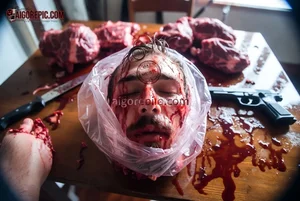
When the cavity was empty they took the cleaver—her cleaver—and separated the head. The cut was made just below the jaw, the same place she had always preferred for a clean break. The head came free with a dull sound. They placed it carefully on the bed of shoulder meat she had prepared that afternoon for the next day’s sale. The eyes remained open.
The body was then split. The saw she used for backbone work was taken from its nail. The large one worked the blade down the length of the spine until the carcass opened like a book. The two halves were jointed at the shoulders and hips. Each piece was arranged on the counter exactly as Elara had arranged pork for twenty-three years: forequarters to the left, hindquarters to the right, belly in the center, trotters in a neat row. The blood basin was set at the front. The knives were wiped and laid across the breastbone of the left half.
Throughout the process Elara’s remaining awareness flickered. She felt the rope, the cold, the progressive lightening of her body as pieces left her. She heard her own voice—high, broken—pleading that she had never meant harm, that the pigs were only animals, that she had children once and a husband and a life that had already taken enough. The creatures did not answer every word. When they did, the answers were the same.
“You made the choice every morning. We make it only once.”
By the time the last joint was separated she no longer moved. The large one checked the pupils of the head on the counter, nodded once, and stepped back.
“It is finished. The counter is hers again.”
They left the way they had come, through the door that made no sound. The fog took them. Behind them the stall waited for morning, the meat laid out with professional care, the head watching the empty lane with open eyes.
Gareth finished the account and wiped his mouth with the back of his hand. The clerk asked why no one else had seen. Gareth said the pig-men walked only when the fog was thick enough to hide the shape of a snout. He said they had been waiting years for a night when the debt came due. He said he had watched through the knothole in the rear wall because he had been sleeping in the woodpile and the light of the stove had drawn him.
The clerk wrote it all down and never showed the notes to the constable. The village preferred the simpler story: a madwoman had somehow butchered herself, or a rival had done it and fled. The boarded stall remained. Children were told not to play near it. On certain October nights when the fog came down heavy and the pigs in the outlying pens grew restless, people still locked their doors early and did not look toward the market square.
No second killing came. The fear, however, never fully left. It lived in the way a woman would pause before buying a joint of pork, in the way a man would glance at the beam in his own shed, in the silence that fell whenever someone mentioned Widow Crowe’s name.
Gareth died two winters later of the drink. The clerk kept the notes in a locked drawer until his own death. The story passed into the kind of local talk that is half-dismissed and half-believed, the kind that makes a person check the latch twice without admitting why.
In Blackthorn Vale the fog still rises. The pens still fill. And somewhere in the dark the debt, once collected, is remembered.