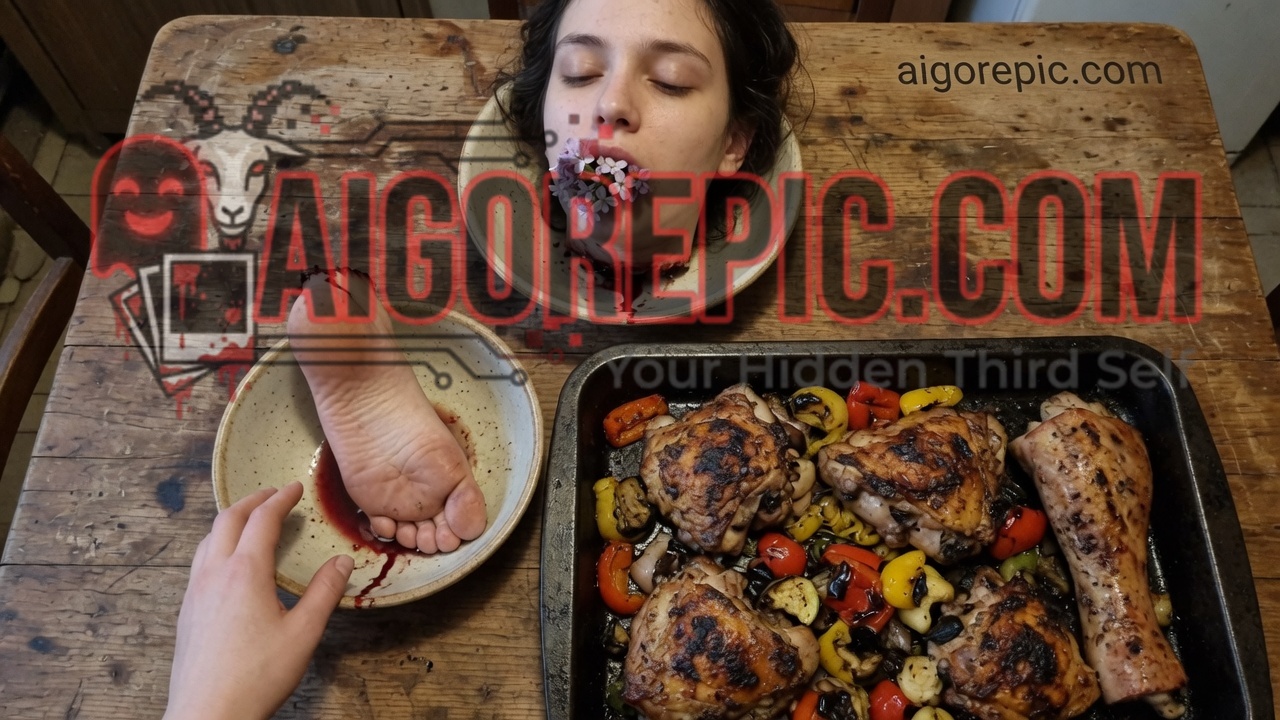
Disclaimer
The following story is a work of fiction. All characters, events, locations, and incidents are either the products of the author’s imagination or used fictitiously. Any resemblance to actual persons, living or dead, or actual events is purely coincidental. This narrative contains mature themes, including gore, cannibalism, psychological horror, and specific fetishes related to death and dismemberment (thanatophilia and carniphilia). Reader discretion is advised.
Chapter 1: The Quiet Monster
The rain in Seattle did not wash things clean; it merely made the grime slicker, turning the city into a shimmering canvas of gray and neon. For Eleanor Vance, this was comforting. It blurred the edges of the world, softening the harsh lines of reality until they resembled the ink strokes of her favorite novels.
Eleanor was thirty-two years old, an actuary by trade, and a woman who blended seamlessly into the background of corporate life. She wore beige cardigans, sensible heels, and carried a leather tote bag that smelled faintly of vanilla and old paper. Her hair was pulled back in a severe bun, not out of style, but for utility. To her colleagues at Henderson & Associates, she was efficient, quiet, and utterly unremarkable.
But beneath the beige exterior lay a mind that churned with dark, viscous imagery. While others saw a sunset as a romantic spectacle, Eleanor saw it as blood spattering across a white sheet. She didn’t just like horror novels; she craved them. Specifically, she loved the visceral details of the slasher genre—the crunch of bone, the spray of arterial red, and the ultimate silence that followed.
Her apartment was her sanctuary. It was sparse, save for one wall entirely dedicated to books: first editions of classic gore fiction, scripts, drafts, and obscure Japanese novels about ritualistic dismemberment. On her desk sat a laptop glowing with the interface of “The Butcher’s Block,” an exclusive online forum for connoisseurs of macabre literature.
Eleanor typed rapidly. She was publishing her latest work, The Anatomy of Silence. It wasn’t just a story; it was a diary of her fantasies. In the book, the protagonist, a woman named Clara, didn’t simply die; she was curated. Her body parts were arranged like sculptures in a museum of flesh.
She hit Publish. Within minutes, notifications pinged.
“The description of the decapitation gave me chills!”
“I can smell the iron through the screen.”
“Who is this author? I want to meet her.”
Eleanor smiled, a small, secretive curve of her lips. She was tired of reading about it. She wanted to experience it.
For years she had scoured the forum looking for someone with the discipline she sought. Most were amateurs. Then, three months ago, a user named Kael_09 appeared. Profile: Former Special Forces. Balkans. Precise, military-grade writing mixed with poetic brutality. He posted rarely—usually a single image of a blade or a battlefield.
Eleanor messaged first.
“Do you enjoy the art of disassembly?”
Two days later:
“Art requires patience. Most people are messy. Are you?”
“I am very patient. And I have money.”
The negotiation took weeks via encrypted chat. Kael was cold and direct.
“I prefer the head intact. It allows for eye contact during the final moment. The rest… I will distribute.”
The price was fifty thousand dollars. Eleanor had saved every overtime shift and sold her vintage jewelry. It was everything.
Tonight the rain tapped against the window. 7:00 p.m. Kael had said he would come between eight and nine. She poured a glass of red wine—she rarely drank, but tonight she needed a little courage. She imagined the liquid was blood.
Her phone buzzed. Unknown number.
Kael: I am outside.
She opened the door. The hallway was empty. Then a figure emerged from the stairwell: tall, broad-shouldered, dark tactical jacket, beanie and scarf obscuring most of his face. Pale blue eyes, sharp and cold.
He held up a small inhaler.
“Deep breaths, Eleanor. Don’t fight it.”
The scent was sweet and chemical. Her knees buckled. He caught her before she hit the floor and carried her out into the rainy night.
Her last clear thought was not fear, but excitement.
It’s happening.
Chapter 2: The Abattoir
Consciousness returned in fragments—damp earth, rusted metal, the slow drip of water. Eleanor opened her eyes. She lay on a wooden table in a large circular room lined with hooks and tools. A single bulb hung overhead. Her wrists and ankles were bound with thick leather straps. Her body felt heavy from the drug, but her mind was sharp.
The door creaked. Kael entered without scarf or beanie. Short cropped hair, a scar through his left eyebrow, white apron already stained. He set down a tray: a long curved knife, heavy shears, a bowl of coarse salt.
“You look peaceful,” he said, running a cool finger along her jaw.
“Where are we?”
“An old textile factory on the edge of the city. Abandoned for twenty years.” He leaned closer. “I don’t like waste. And I don’t like screaming. You’re not a screamer, are you?”
“No.”
“Good.” He sprinkled a pinch of salt onto the skin over her heart. The crystals bit. She gasped, but the sharp pain made her feel more alive than she had in years.
He placed the tip of the knife at the center of her sternum and pressed slowly. The skin parted with a soft sound. A thin line of blood welled and began to trickle. He worked with deliberation—upward from navel toward throat, precise, never rushing. Eleanor watched the wound open, the white layer of tissue, the red muscle beneath. It felt like a hot breath across her insides.
He pulled the flaps of skin back, exposing the ribcage, then used the shears. One crisp crack through the sternum. The pressure changed; she drew a rattling breath.
“Does it hurt?”
“A little. Mostly… I feel light.”
“Lightness is freedom.”
He closed the larger openings with temporary black stitches and packed the cavity lightly so she would not bleed out too quickly. Then he released the straps on her limbs one by one and began the careful work of separating them. First the left arm at the shoulder, then the right, then each leg. He worked efficiently, sealing the major vessels as he went. Within a short time Eleanor was a living torso. The blood pooled around her waist in a small red lake. She felt no pain in the missing limbs—only a distant ache and a strange, floating numbness.
Kael stepped back. “Clean cuts. No ragged edges.” He held up a simple diagram. “Your left hand will go to the park where you read every Sunday. Your right foot to the fountain at the university library. Your head… will stay with me a little longer, then go to the highest point in the city.”
He placed the severed hands and feet into sterilized glass jars filled with brine, labeled them, and carried them out to a van. When he returned, Eleanor was alone in the warmer adjacent chamber. Her heartbeat had slowed. She closed her eyes and imagined the city receiving her pieces.
Chapter 3: The Feast
Time passed in a haze of sedatives and carefully measured pain. On the third day Kael woke her.
“Today is the final act.”
He had kept her stable enough. The major wounds were closed with temporary sutures; the blood loss had been controlled. She was weak and dizzy, but conscious. He helped her sit upright—her remaining torso balanced carefully—and led her back to the main room. The table had been cleaned. Plates, cutlery, a bottle of wine, a single candle.
From a cooler he brought a tray. Four pieces of meat, raw and glistening: two from her thighs, one from her shoulder, one smaller piece from her breast. He had taken them during the earlier work and marinated them.
“I’ve been preparing these,” he said. “Rosemary, garlic, a little red wine. I wanted to taste you before the end.”
He cooked the portions lightly over a small burner, served them, and sat opposite her. He cut a piece, chewed slowly, eyes closed.
“Salty. Tender. You eat well, Eleanor. Lean but flavorful.”
She took a small piece with her remaining strength and brought it to her mouth. The taste was rich, gamey, sweet with iron and salt. Tears pricked her eyes.
“It’s good,” she whispered. “Better than I imagined.”
They ate in silence. When they finished he poured wine.
“To you. The muse.”
“To us. The artist and the canvas.”
Afterward he led her to a chair facing a large ornate mirror that looked out of place in the industrial room. He stood behind her, knife in hand.
“Look at yourself. See what you are becoming.”
Eleanor’s face was pale, eyes wide and dark with excitement. Her hair fell loose around her shoulders. She looked terrifyingly beautiful.
Kael placed one hand on her shoulder to steady her.
“Ready?”
“Yes.”
He positioned the blade at the base of her skull.
Slice.
A rush of warmth. The wet sound of muscle, vein, artery, then the brief resistance of the spine. For a moment there was only lightness. Her head tilted forward. Kael held it steady. In the mirror her eyes remained open a few seconds longer—wide, unblinking—before the light in them faded.
He lifted the head carefully and placed it on a velvet cushion. He cleaned her face with a cloth, brushed her hair, and, after a moment’s hesitation, closed her eyes. He poured a small amount of preservative fluid into the mouth and throat, then sealed the head in a clear plastic bag, removing as much air as possible.
The body was packed into ice-lined boxes. The head went into a cooler with dry ice. Kael looked at the bag one last time.
“Sleep well, Eleanor. You’ve earned your rest.”
He blew out the candle.
Chapter 4: The Distribution
The next morning Kael loaded the cooler and the jars into his van.
The Park
Early Sunday. Mist rose from the grass. He placed the jar containing her left hand on the bench near the pond where she used to read. A small typed note: For the reader.
A jogger found it later, photographed the floating pale hand, and posted it. The image spread quickly under a curious hashtag before the police arrived and removed it.
The University Library
By midday he stood at the central fountain. He let the right foot fall into the water among the coins. Students gathered, photographed, argued whether it was real. Within an hour campus security and police had secured the area.
The Space Needle
That evening, using a contact who owed him a favor, Kael reached the observation deck after closing. He propped the preserved head against the glass, facing the city lights, for only a short time—long enough to take a single photograph. Then he removed it again. The image, posted anonymously on The Butcher’s Block with the caption She is everywhere now, was enough. The head itself was never left to be discovered by the public; the legend would grow from the photograph and the other two finds.
Comments flooded the forum.
“That’s her.”
“Beautiful.”
“Who is he?”
Kael did not answer. He looked once more at the city below and left.
Chapter 5: The Aftermath
A week later a worried friend cleaned out Eleanor’s apartment. The laptop still displayed the final chapter of The Anatomy of Silence:
And so Clara ceased to be one body and became many. She was in the park, watching the leaves fall. She was in the fountain, dancing with the coins. And she was high above, looking down at the world that had once held her captive. She was no longer afraid of death. She had become it. And in becoming it, she had found a kind of eternal life.
The friend shivered and looked toward the skyline. For a moment she thought she saw a shape high on the Space Needle. She blinked, and it was gone.
Chapter 6: Kael’s Journal
Kael sat in his small apartment and opened a new journal.
Eleanor Vance was my masterpiece. She understood the beauty of destruction. Most people fear the end. They cling to their bodies, their identities, their lives. Eleanor let go. She gave herself freely. In return I gave her a form of immortality.
She is scattered now—hand, foot, and the memory of a head against the glass. Every time someone sees one of her parts, or the photograph, they think of her. That is the power of art. It outlasts both the artist and the subject.
I am already looking for the next muse. No one will ever compare to Eleanor. She was perfect.
He closed the journal and placed it beside a framed photograph of a bloody knife and a single red rose.
Outside, the rain began again.
Epilogue: The Legacy
Months passed. The story of the hand in the park, the foot in the fountain, and the photograph from the Space Needle became a local legend. Tourists asked about it. Students still threw coins near the fountain. Artists painted murals. People dressed as the quiet woman in the beige cardigan for Halloween, holding empty jars.
Kael watched from a distance. He never returned to the sites.
One evening an email arrived:
I saw your work. It made me want the same. Are you looking for another?
Kael typed a single reply:
Always.
He closed the laptop. Somewhere in the rain and neon of Seattle, the idea of Eleanor Vance continued—alive in every rumor, every photograph, every shiver of curiosity that ran through the city.
She was dead.
But she had never been more present.