Disclaimer:
This is a work of historical fiction inspired by the provided image. The story contains graphic depictions of violence, execution, and bloodshed. It is intended for mature audiences only.
All characters and events depicted in this story are entirely fictional and do not represent any real historical figures or actual events. The content is written solely for artistic and narrative purposes.
Reader discretion is strongly advised.
---------------------------------------------------
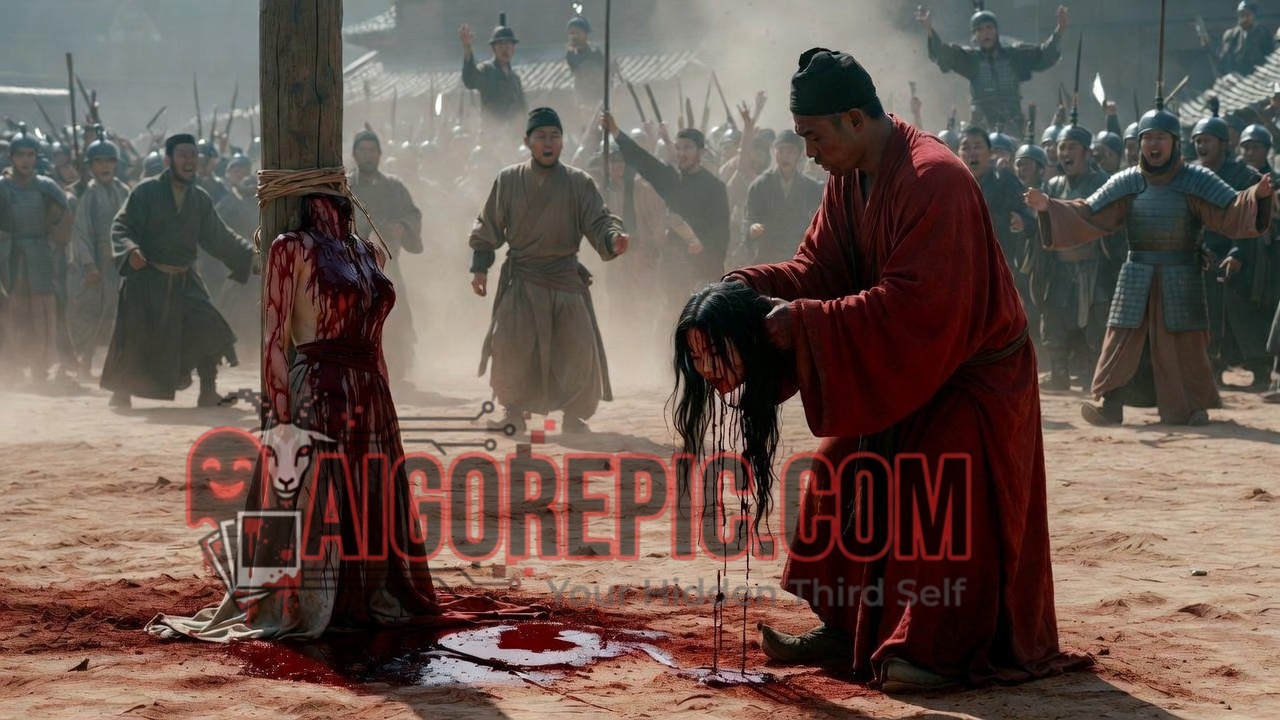
The dusty square of the frontier garrison town baked under a merciless sun. A wooden post stood like a silent sentinel in the center of the blood-soaked ground. Tied to it was a woman in a once-white robe now stained crimson. Her head was missing—severed cleanly at the neck hours earlier. Thick ropes of blood still dripped slowly from the stump, pooling around her bare feet and soaking the hem of her garment. The air reeked of iron and dust.
A few paces away, the executioner in his deep red robe knelt on one knee. His powerful hands gripped the long, wet black hair of the second condemned woman. He had just lifted her severed head high enough for the roaring crowd to see. Blood streamed in thick rivulets from the clean cut at the neck, splattering onto the dry earth and forming a dark puddle between his boots.
The woman’s face—pale, beautiful even in death—still wore a defiant expression. Her eyes were half-closed, lips slightly parted as if she had spoken her last curse only moments ago. Long strands of hair clung to her cheeks, matted with blood.
Behind them, the crowd of soldiers and townspeople surged forward, shouting in triumph. Some raised spears and swords, others shook their fists. Their faces were twisted with hatred and bloodlust. Dust swirled around their legs like smoke from a battlefield.
This was the second execution of the day.
The first had been swift. The woman now tied to the post had been a known leader among the rebel forces that had risen against the Emperor’s rule. Captured after a brutal skirmish in the northern provinces, she had refused to speak a single word during interrogation. No names. No confessions. No betrayals. Even under the lash and the hot irons, she had stared at her captors with cold, unyielding eyes.
They called her “the Silent Blade.”
When they dragged her into the square that morning, she walked with her head high, back straight, despite the bruises and cuts covering her body. The crowd jeered, but she never flinched. She did not beg. She did not cry.
The executioner had raised his heavy blade once. The crowd fell silent for a heartbeat.
Then the sword fell.
A clean, powerful stroke. Her head dropped into the dust with a wet thud. Her body remained standing for a long second, tied upright by the ropes, before blood gushed from the neck like a fountain. The white robe turned scarlet in moments. The body twitched once, twice, then hung limp against the post.
The crowd erupted in cheers.
Now it was the turn of her younger companion—the woman whose head the executioner now held aloft.
She had been captured alongside the Silent Blade. A fierce fighter, they said. She too had refused to talk, spitting in the face of the interrogators even as they broke her fingers. When they brought her out, she had screamed defiance at the crowd, calling them cowards and slaves of a corrupt court.
“Long live the rebellion!” she had shouted, voice raw but unbroken. “The Emperor’s throne will burn!”
The executioner had forced her to her knees in front of the post where her comrade’s headless body still stood as a warning. She had struggled, cursing him with every breath.
He had not spoken. Executioners rarely did.
With practiced strength, he grabbed her hair, pulled her head back to expose the neck, and swung the blade in one smooth arc.
The sound was sickening—metal slicing through flesh and bone. Her body jerked violently. For a fraction of a second, her head remained attached by a thin strip of skin, then it fell forward, held only by the executioner’s grip on her hair.
He lifted it high now, turning it slowly so every soldier and villager could see the face of the defeated rebel.
Blood poured from the severed neck in steady streams, dripping onto his red robe and the ground. The woman’s long black hair hung heavy and wet, strands stretching down like dark threads soaked in crimson.
The crowd roared louder than before. Spears thrust into the air. Helmets glinted under the sun. Some soldiers beat their chests and shouted victory chants.
The executioner remained kneeling, holding the head steady. His face was calm, almost solemn. This was his duty—nothing more, nothing less. The red of his robe was not chosen for ceremony; it was practical. Blood did not show as clearly on red.
Behind him, the headless body of the first woman continued to bleed slowly, the pool of blood spreading wider across the dirt. The second head dripped in rhythm, adding to the growing stain.
In the distance, more soldiers watched from the edges of the square, their armor dusty, their expressions hard. This was justice, they told themselves. This was how rebellions ended—in dust, in blood, and in silence.
The executioner finally lowered the head slightly, preparing to place it beside the body of her comrade as a final warning to any who still harbored thoughts of revolt.
The wind picked up, carrying the metallic smell of blood across the square.
Two women. Two rebels. Two lives ended by the same blade.
And the crowd kept cheering, as if the blood on the ground could wash away the fear that the rebellion might one day rise again.
End.