Disclaimer: This is a work of historical fiction inspired by documented accounts of famine-induced cannibalism in ancient China. It contains graphic descriptions of violence, dehumanization, and horror. The content is intended for mature audiences only and does not glorify or endorse such acts. These events reflect extreme human suffering under catastrophic conditions, not normal or acceptable behavior. Reader discretion is strongly advised.
Author: aigorepic.com
--------------------------------------
In the final years of the Ming Dynasty, under Emperor Chongzhen, the heavens themselves seemed to turn against the land. Henan and Shandong provinces withered under relentless drought. Locusts descended like black clouds, stripping fields bare until even the bark of trees and roots in the earth vanished. The people, once farmers and weavers, became shadows of themselves—skin stretched over bones, eyes hollow with despair.
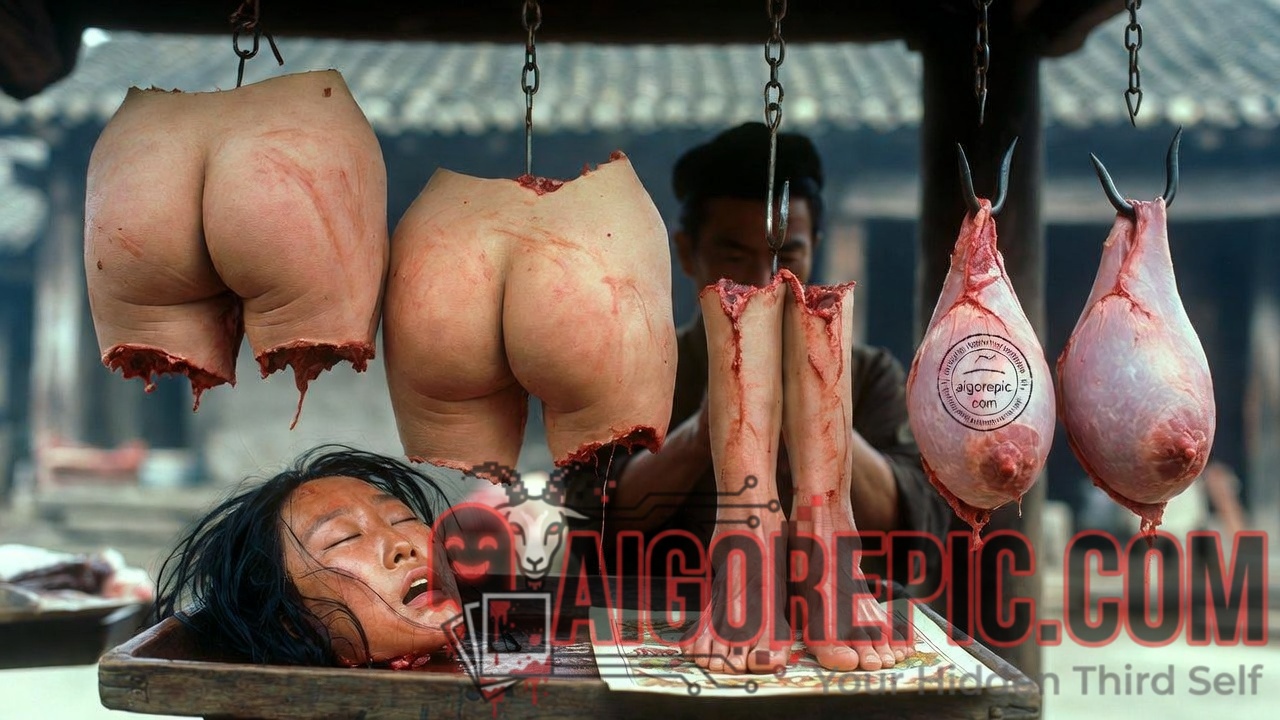
In the market town of Kaifeng's outskirts, where the Yellow River had long since dried to cracked mud, a butcher's stall stood beneath a sagging wooden awning. Chains dangled from the rafters, hooks glinting in the weak sunlight. The air reeked of blood and flies. Among the usual cuts—pork haunches, lamb legs—hung stranger wares: pale, severed limbs, still glistening, arranged meticulously like prized livestock parts. But the true horror lay on the ground below.
A young woman named Lian, no more than twenty, lay bound on a rough wooden tray. Her wrists and ankles were tied tightly behind her back with coarse rope, forcing her body into an arched, helpless curve. She was stripped bare, her skin marred by bruises and the marks of rough handling. Her long black hair, once braided in the fashion of village maidens, now spilled across the blood-stained boards like spilled ink. Her eyes were closed, lips parted in shallow breaths, as if willing herself into unconsciousness to escape the reality around her.
Above her hung the lower halves of other women—thighs and buttocks severed at the hip, hooked through the flesh and swaying gently like grotesque pendulums. The cuts were clean, professional; the butcher knew his trade. Blood dripped slowly onto the ground, pooling near Lian's head. A man in a stained apron worked nearby, sharpening a cleaver with rhythmic strokes. Customers milled about—haggard men with coins clutched in trembling hands—inspecting the merchandise with the detached gaze of those who had long since abandoned shame.
Lian had not always been here. She was the daughter of a small landowner near Luoyang. Her family had survived the first year of drought by boiling grass and grinding bark into paste. When the locusts came, they devoured even that. Her father sold their last ox; then her mother weakened and died. Bandits took the rest. One night, desperate traders—men who once bought grain but now traded in flesh—dragged Lian from the ruins of her home. They called her "two-legged sheep," cheaper than four-legged ones, easier to transport. In the markets, the term "cairen" had taken hold: humans sold as vegetables, alive or freshly slaughtered.
She remembered the journey: bound in a cart with others, naked to the cold wind, prodded like cattle. Some wept; others stared blankly, already broken. At the market, they were displayed—hands tied behind, forced to kneel or lie, inspected for tenderness, youth, fullness. The butcher had chosen her for her smooth skin and rounded limbs. "Good meat," he muttered, slapping her thigh as one might test a hog.
Now, as the sun climbed higher, the butcher approached. He grabbed Lian's hair, yanking her head back. "This one first," he called to a waiting customer. "Fresh, no gristle. The legs will fetch well—tender as pork."
Lian opened her eyes. They were dark pools of terror, yet a flicker of defiance remained. She did not scream; screams had long since become useless. Instead, she whispered a prayer to ancestors she no longer believed could hear.
The cleaver rose. In the distance, a merchant haggled over a hanging haunch, praising its marbling. Another buyer pointed to Lian's form. "How much for the whole?" he asked. "Live or dressed?"
The butcher laughed, a dry, hollow sound. "Live costs more—keeps the blood fresh. But dressed is quicker."
Steel flashed. Lian closed her eyes again.
In the annals of that famine year, thousands vanished into such stalls. Historians would later record the horror in sparse words: women and the vulnerable bound and sold as "cairen," slaughtered like animals, their parts hung for sale. Ji Xiaolan, the great scholar of the following Qing Dynasty, would hear tales from elders and commit them to his notes—not to sensationalize, but to remind posterity of what despair could reduce humanity to.
Yet in the market that day, no one spoke of history. There was only hunger, the clink of coins, and the drip of blood on dusty earth.
The Great Hunger claimed its due. And the two-legged sheep paid the price.